Jumeirah Palm. Idea, construction and life.

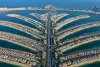
When Dubai was not yet one of the main cities for global luxury tourism, the sheikh would meet rare foreigners on the streets of the city and ask them what brought them to Dubai, because there are no beautiful historical cathedrals, neighborhoods and monuments like in Europe.
The answer was unambiguous - the sea and the sun. And these two tourist symbols meet on the beaches.
Sheikh understood that tourists are attracted to good sandy beaches, because people like to look at the sea, live near it, meet sunsets on the shore and swim in the cool sea water.
Dubai originally had a flat coastline 72 kilometers long. To the left and right along the sea spread the ports of Rashid and Jebel Ali, as well as blocks of desalination plants. They took away quite a bit of the strategically important coastline.
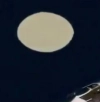
Then the sheikh got the idea to build an artificial island to extend the length of the city's beaches. The architects initially proposed a circular shaped island. It would have added 7 kilometers to the coast of Dubai. But the sheikh rejected the project - too small.
The second version of the island was in the shape of a sun. But it had disadvantages in terms of traffic organization. The Sheikh asked to add a main road and as a result of these additions the sketch began to resemble a date palm.
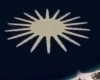
This geometry allowed the city's natural coastline to be doubled, adding as much as 70 kilometers to its length. The project was approved.
During Cityscape Dubai in 2001, Sheikh Mohammed announced that Dubai would build one of the most ambitious projects in the world - a palm-shaped island called the Palm Jumeirah."
For many years, there were only a handful of man-made structures in the world that can be seen from space with the naked eye. The first of these objects was the Great Wall of China, now another one has been added to this small list - the Jumeirah Palm.
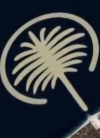
Creating a complexly shaped island with 17 branches, many curved edges, and only two parallel "trunk" lines was a real challenge for engineers and builders.
To ensure the correct application of sand in the sea, the designers decided to use the DGPS global positioning system and the IKONOS satellite, which allows photos from space within minutes.
All marine and land-based equipment that was used for sand and rock placement was equipped with GPS. The data was transmitted to a special coordination program designed specifically for island construction.
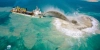
To protect the island from the effects of waves, extreme storms and strong northwesterly winds engineers decided to build an 11 km long breakwater in the shape of a crescent moon along the crown of the island. After compiling a computer model of the movement of water flows, the breakwater made two 150-meter passages that serve to renew the water inside Palma.
Two types of boulders are used for the breakwater, the first weighing 6 tons and the size of a small car and the second smaller boulders weighing up to 1 ton each.
Sand. After a series of experiments, it became clear to engineers that for the construction of the island sand from the desert can not be used, because its particles are too smooth surface - it will wash away. The sand would have to come from the seabed.
Special ships 11 kilometers offshore sucked sand from the seabed using a hydraulic pump and pumped it into large internal bunkers. Excess water was removed through a special overflow system.
The order of works was strictly defined. During the first year the sand was dumped five meters below sea level. Considering that the construction of the breakwater had just begun, the protection it provided, as well as the impact of the waves on it, was minimal.
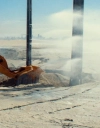
By the second year of construction, the breakwater had reached the level necessary to provide protection. Then a final layer of sand was placed over the water in the areas protected by the breakwater and the island took its final shape. But it was not yet possible to build houses on this new land - the soil needed to become dense.
Naturally settling and compacting the rocks could take decades, and once again technology came to the Sheiks' rescue.
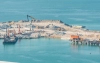
Vibrating machines drove onto the island. They drilled 200,000 wells 12 meters deep and up to 5 meters in diameter, into which a special vibrating mechanism was lowered to compact the sand, and then another final layer was added - the island is ready. You can start building houses.
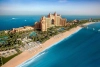
It cost Dubai $12 billion dollars to build the island.
There are 1,500 beach villas built on 17 "branches" of the Palm. On average per "branch" is 100 mansions. Each has a pool and access to a piece of the sea.On the western side of the "trunk" recently opened the coolest West Beach, in style reminiscent of the wide beaches of Florida with slender rows of palm trees and dozens of restaurants. There are also five-star hotels and residences with apartments.
Most hotels and premium residential complexes, including the famous Atlantis The Palm hotel, are located on the 11-kilometer "crescent". Recently, sales of the Six Senses project with top hotel services have started here. For real estate in Dubai, visit Whitewill.
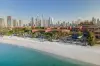
By the way, one of the most expensive projects on Palma - the villa complex "22 Karata" was built by a developer from Yekaterinburg. The most expensive villa there was sold for $30m.
There are two marinas on Palm: Palm Jumeirah East and Palm Jumeirah West. They have 269 berths each and accept vessels from 10 to 36 meters in length.
The Palm Monorail runs 5.4 kilometers across the island. The train runs with several stops from Palm Gateway Station to the Atlantis Hotel and can carry up to 6,000 people per hour.
Along the monorail stretches the eco-friendly Al Ittihad Park, a 10-hectare park with a 3.2 kilometer long running track. It is the first park in Dubai to use only native plants that require minimal watering.
There are two shopping centers on the "trunk", The Point and Nakheel Mall.
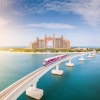
The Point features dozens of cozy restaurants overlooking the sea and Atlantis. It also has its own fountain show. For lovers of our cuisine there is "chalet Berezka" - the main meeting place of the local Russian-speaking party with olivier, borscht and borodinsky bread, but with cool interest and karaoke.
Nakhil Mall has an observation deck on the 52nd floor level of the Palm Tower. Upon entering the observation deck, you will be greeted by the Palm Jumeirah Creation History Room.
